Table Setting Infographic: A Strategic Guide to Visual Planning and Execution
In the realm of visual communication and event planning, clarity is often the difference between a successful execution and a chaotic experience. A Table Setting Infographic serves as more than a decorative diagram; it is a tactical blueprint that translates complex spatial arrangements into immediate, actionable intelligence. For professionals managing operations, educators teaching hospitality, or entrepreneurs curating brand experiences, this visual tool bridges the gap between abstract design concepts and physical reality. It standardizes expectations, reduces cognitive load for staff, and ensures that every element on the surface aligns with the intended outcome.
The strategic value of a Table Setting Infographic lies in its ability to codify standards. When you move beyond simple verbal instructions or text-based checklists, you leverage the human brain's superior capacity for processing visual data. A well-designed modern flat infographic removes ambiguity regarding placement, hierarchy, and aesthetic balance. Whether you are orchestrating a high-stakes corporate dinner, launching a new catering service, or training a team of servers, this visual asset acts as a single source of truth. It ensures that the final presentation matches the vision without requiring constant supervision or micromanagement during the critical setup phase.
Defining the Modern Flat Illustration Approach
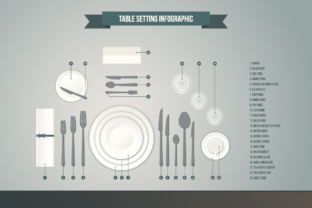
Contemporary design trends have shifted away from cluttered, photorealistic diagrams toward clean, modern flat illustrations. This style is not merely an aesthetic choice but a functional necessity for effective communication. A modern flat infographic illustration strips away unnecessary textures and shadows, focusing strictly on the geometry and relationships between objects. By using distinct colors and clear outlines, these visuals make it instantly obvious where a fork belongs relative to a knife, or how a centerpiece should be positioned to allow for conversation flow.
This approach supports better decision-making by reducing visual noise. In a fast-paced environment, a server or event coordinator does not have time to decipher a dense photograph or a convoluted 3D rendering. The flat style offers a top-down, schematic view that mimics the perspective of someone actually setting the table. It simplifies the learning curve for new employees and provides a consistent reference point for seasoned professionals. When you adopt this style for your Table Setting Infographic, you are prioritizing speed of comprehension and accuracy of execution over artistic flair.
Strategic Applications Across Industries
The utility of a Table Setting Infographic extends far beyond the restaurant industry. It is a versatile tool for various sectors where presentation and protocol matter.
- Hospitality and Catering: For restaurant owners and caterers, consistency is the currency of reputation. An infographic ensures that every guest receives the same level of attention to detail, regardless of which server sets their table. It becomes part of the Standard Operating Procedure (SOP), reducing errors and waste.
- Event Management: Event planners use these guides to communicate with vendors and clients. A visual representation helps stakeholders visualize the final look before any physical items are purchased or moved, preventing costly last-minute changes.
- Educational Institutions: Culinary schools and etiquette instructors rely on these infographics to teach proper placement rules. They provide students with a clear, memorable reference that reinforces theoretical knowledge with practical application.
- Brand Marketing: For lifestyle brands, publishers, and content creators, a custom Table Setting Infographic can serve as valuable content. It demonstrates expertise, engages audiences interested in home entertaining, and positions the brand as an authority on quality and aesthetics.
By integrating this tool into your operational workflow, you transform a routine task into a controlled, repeatable process. This shift allows leadership to focus on higher-level strategy while the team executes with precision based on clear visual directives.
Enhancing Communication and Operational Efficiency
One of the most significant challenges in team management is the "telephone game" effect, where instructions degrade as they pass from manager to supervisor to staff. A Table Setting Infographic eliminates this degradation. It serves as a universal language that transcends linguistic barriers and varying levels of experience. When a visual guide is posted in the kitchen or prep area, it acts as a silent supervisor, ensuring adherence to the established standard.
From a productivity standpoint, the time saved in correcting mistakes is substantial. Without a clear guide, teams may spend minutes debating the correct distance between a wine glass and a plate, or the angle of the utensils. These micro-delays accumulate, slowing down service and increasing stress levels. A well-placed infographic resolves these questions instantly. It empowers employees to act autonomously and confidently, knowing they have a reliable reference at their fingertips.
Furthermore, this tool enhances the customer experience. Guests subconsciously notice the symmetry and order of a table setting. A perfectly aligned setting signals competence and care, elevating the perceived value of the meal or event. Conversely, a haphazard arrangement can undermine even the highest quality food. Therefore, the Table Setting Infographic is an investment in brand perception and customer satisfaction.
Planning and Implementation: A Practical Framework
To leverage a Table Setting Infographic effectively, one must approach its creation and deployment with intentionality. Simply downloading a generic template is rarely sufficient for specific business needs. The process requires a strategic assessment of your goals and context.
- Define the Occasion and Protocol: Determine the formality of the event. Is this a casual brunch, a formal state dinner, or a plated wedding reception? The rules change significantly between these scenarios. Your infographic must reflect the specific protocol required for the occasion.
- Identify Key Components: List every item that will appear on the table. This includes plates, cutlery, glassware, napkins, and centerpieces. Consider the material and color of these items, as they should be represented accurately in the flat illustration to avoid confusion.
- Determine Spatial Relationships: Map out the exact distances and angles. Use industry standards (such as the International Waiter Association guidelines) as a baseline, then adjust for your specific venue constraints. The infographic should clearly show the "zone" for each item.
- Select the Right Visual Style: Choose a modern flat illustration style that matches your brand identity. Ensure the colors used in the graphic correspond to the actual items or are coded consistently (e.g., all silverware in grey, all glassware in blue).
- Distribute and Train: Once created, integrate the infographic into your training materials. Place printed copies in strategic locations and include digital versions in onboarding packets. Conduct a walkthrough where the team practices setting tables using only the visual guide.
This structured approach ensures that the infographic is not just a pretty picture but a functional instrument of operations. It forces the planner to think through every detail before the first chair is pulled out.
Risks of Misapplication and Lack of Context
While powerful, the Table Setting Infographic carries risks if used without clear goals or contextual understanding. One common pitfall is rigidity. A visual guide designed for a formal banquet may be entirely inappropriate for a relaxed family gathering. Applying a strict, rigid standard to an informal setting can create an atmosphere that feels cold or pretentious, alienating guests rather than welcoming them.
Another risk is the assumption that the infographic replaces human judgment. While the guide handles the mechanics of placement, it cannot account for unique guest needs, unexpected space constraints, or last-minute menu changes. Teams must be trained to understand the intent behind the rules—why the fork goes on the left, why the glass is placed at a specific height—so they can adapt when necessary.
Furthermore, relying on a generic, low-quality infographic can lead to misinformation. If the spacing is inaccurate or the items are misidentified, the entire operation suffers. It is crucial to validate the visual against real-world conditions. A guide that looks good on a screen but fails to account for the size of the actual chairs or the weight of the centerpieces is a liability, not an asset.
Long-Term Value and Brand Positioning
When implemented correctly, a Table Setting Infographic contributes to long-term organizational success. It builds a culture of precision and attention to detail. Over time, this discipline permeates other areas of the business, raising the overall standard of operations. For entrepreneurs and small business owners, this consistency is a key differentiator in a crowded market. It signals to customers that the business is professional, organized, and committed to excellence.
For content creators and educators, these infographics serve as evergreen assets. They can be repurposed across blogs, social media channels, and training manuals, extending the reach of your expertise. By providing clear, valuable information, you establish trust and authority within your niche. This aligns with the principles of helpful content, offering users exactly what they need to solve a problem or achieve a goal.
Ultimately, the decision to use a Table Setting Infographic is a decision to prioritize clarity and consistency. It is a strategic move that acknowledges the complexity of human interaction and the importance of the physical environment in shaping that interaction. By investing in thoughtful visual planning, you empower your team, delight your guests, and secure a competitive advantage through superior execution.